Film it like a coach would watch it.
MotionGrade reads your movement from the footage you give it. A coach standing in the wrong place can't see your base either — the camera has exactly the same problem.
Nine measures. How many of them we can read is decided before you press record.
The distance between you and the camera must not change.
Every measure is a ratio against how big your body is on screen. Let the camera drift closer, or run away from it, and the ruler changes mid-measurement — so a movement that never changed reads as though it did.
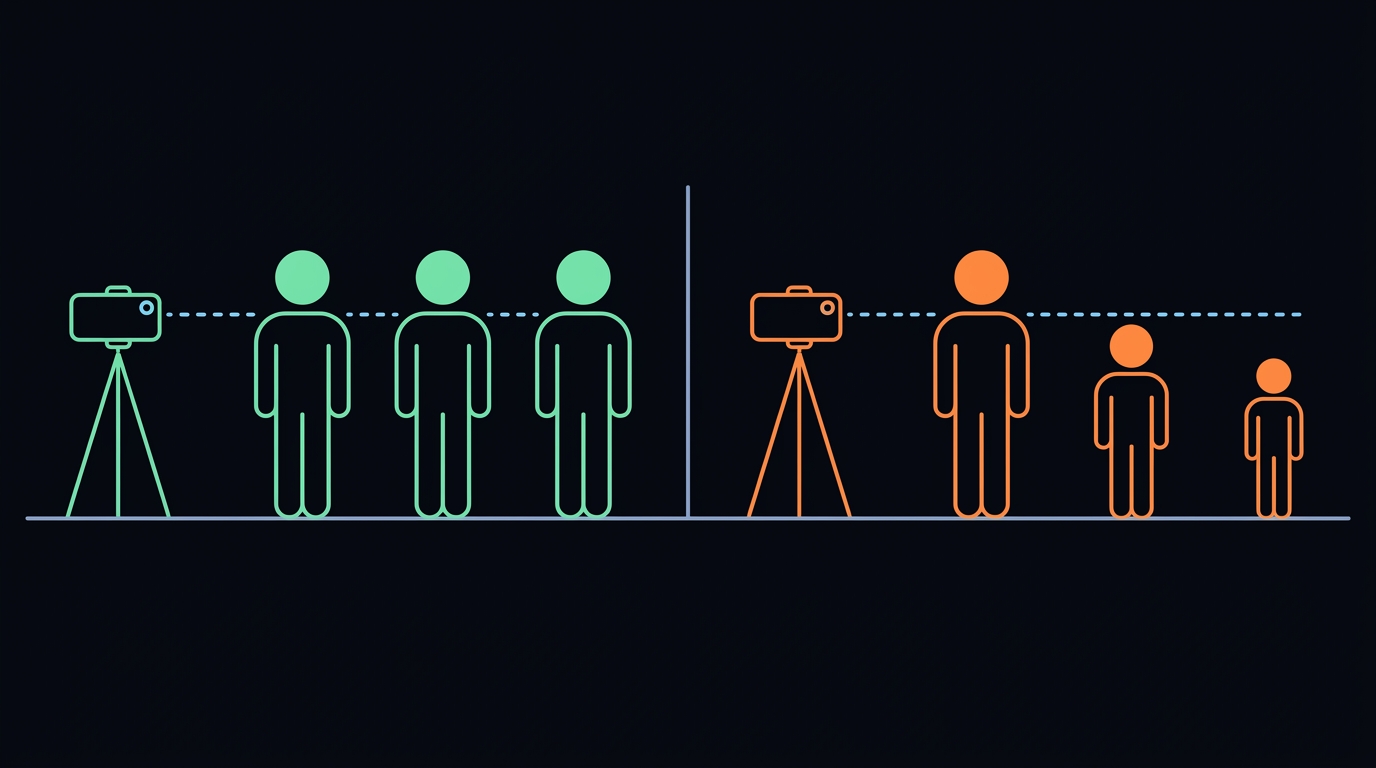 Distance holds
Distance opens up
Distance holds
Distance opens up
It is also why panning is not a fix. Swivelling to keep someone in shot keeps them in frame while the distance carries on changing underneath the measurement. Framing and distance are two different problems, and only one of them is solved by turning the phone.
Stand where the camera can see the gap between your feet.
Almost everything else is lighting and framing. This one is geometry, and it silently costs you three measures.
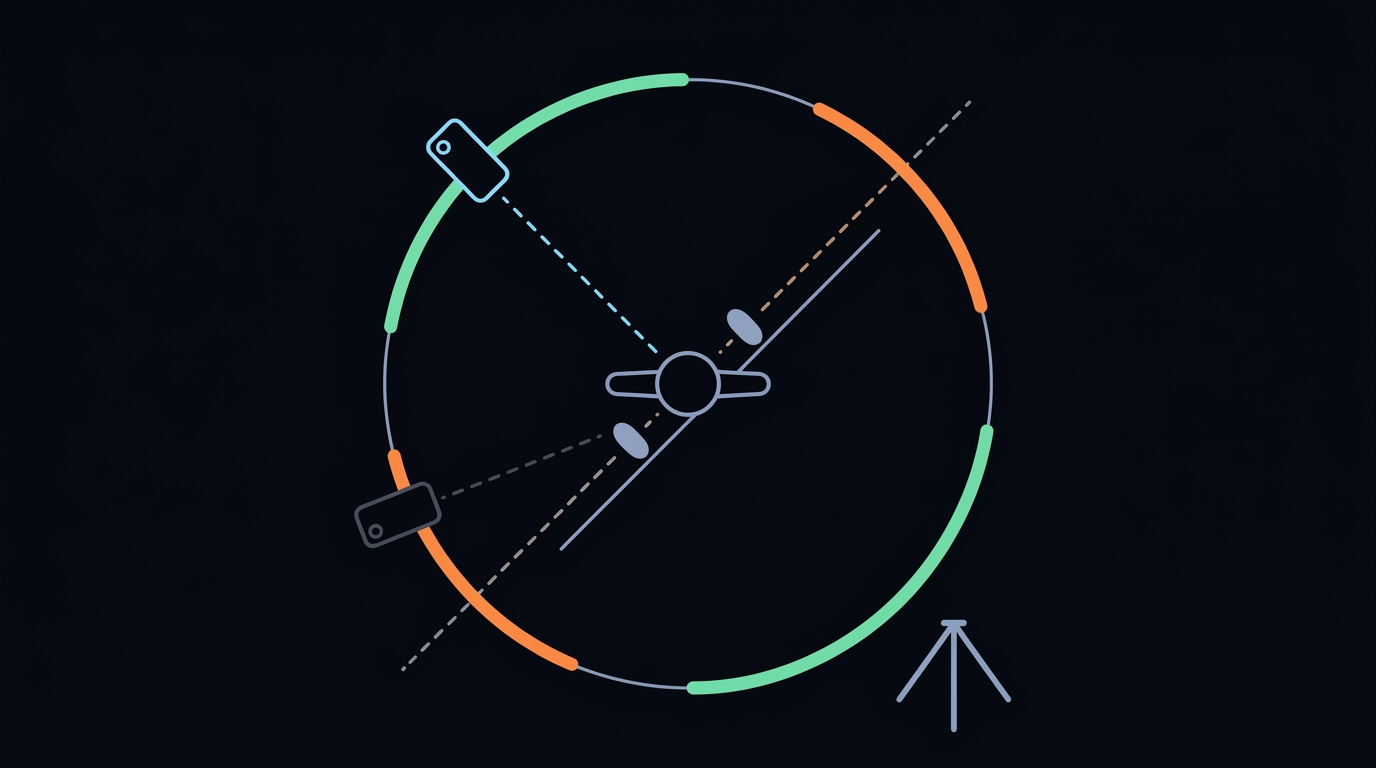 Camera sees both feet
One foot hides the other
Your stance line
Camera sees both feet
One foot hides the other
Your stance line
You can check it before you press record: look at your own screen and see whether there is daylight between your feet. If there is, the base is measurable. If one shoe is hiding behind the other, step the phone around until it isn't.
That's the whole rule — and the next section is what it costs when you get it wrong, measured on real clips rather than asserted.
Some sports hold the distance for you. Running does not.
If you work inside a box — striking, racket sports, throwing, jumping — set the phone down and walk away. If the movement travels, the camera has to travel with it at a fixed gap.
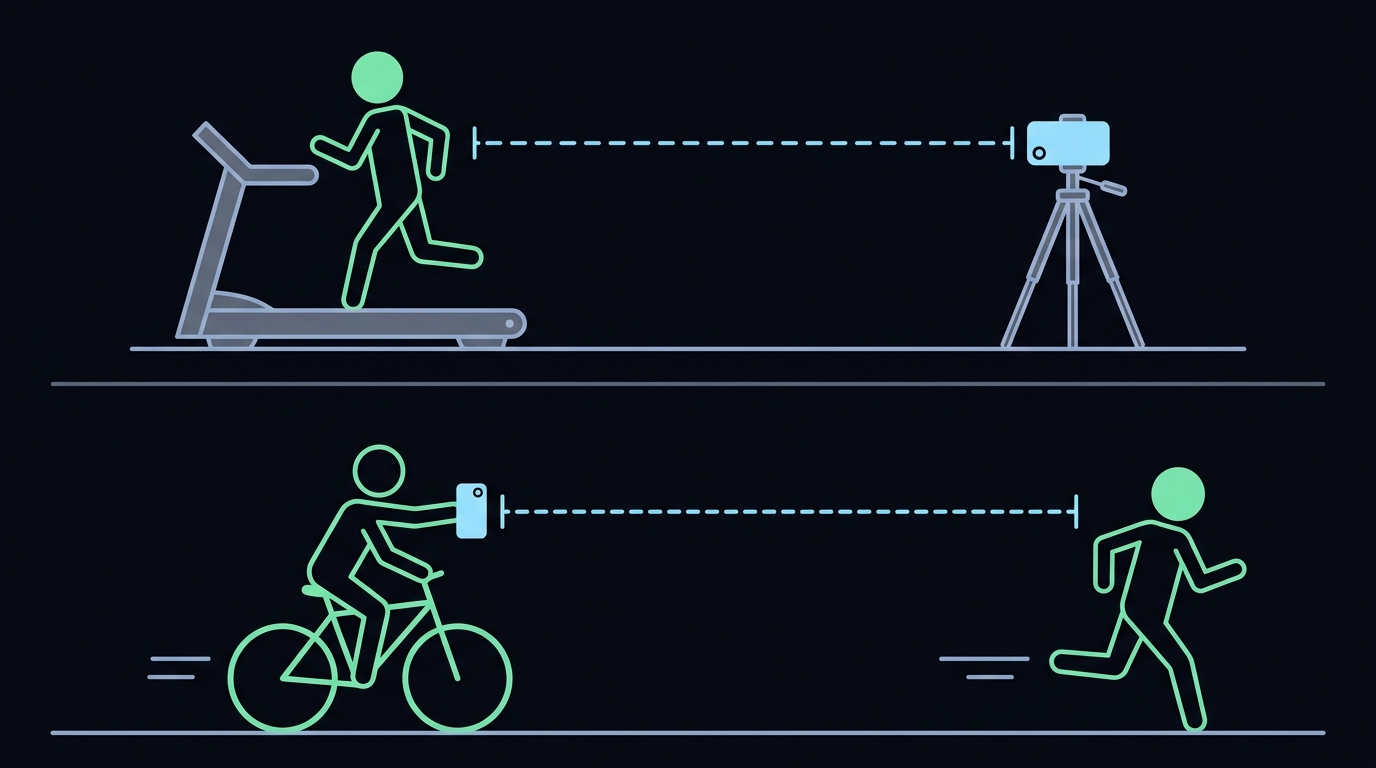 Treadmill, camera holding station
Bike, keeping the same gap
Treadmill, camera holding station
Bike, keeping the same gap
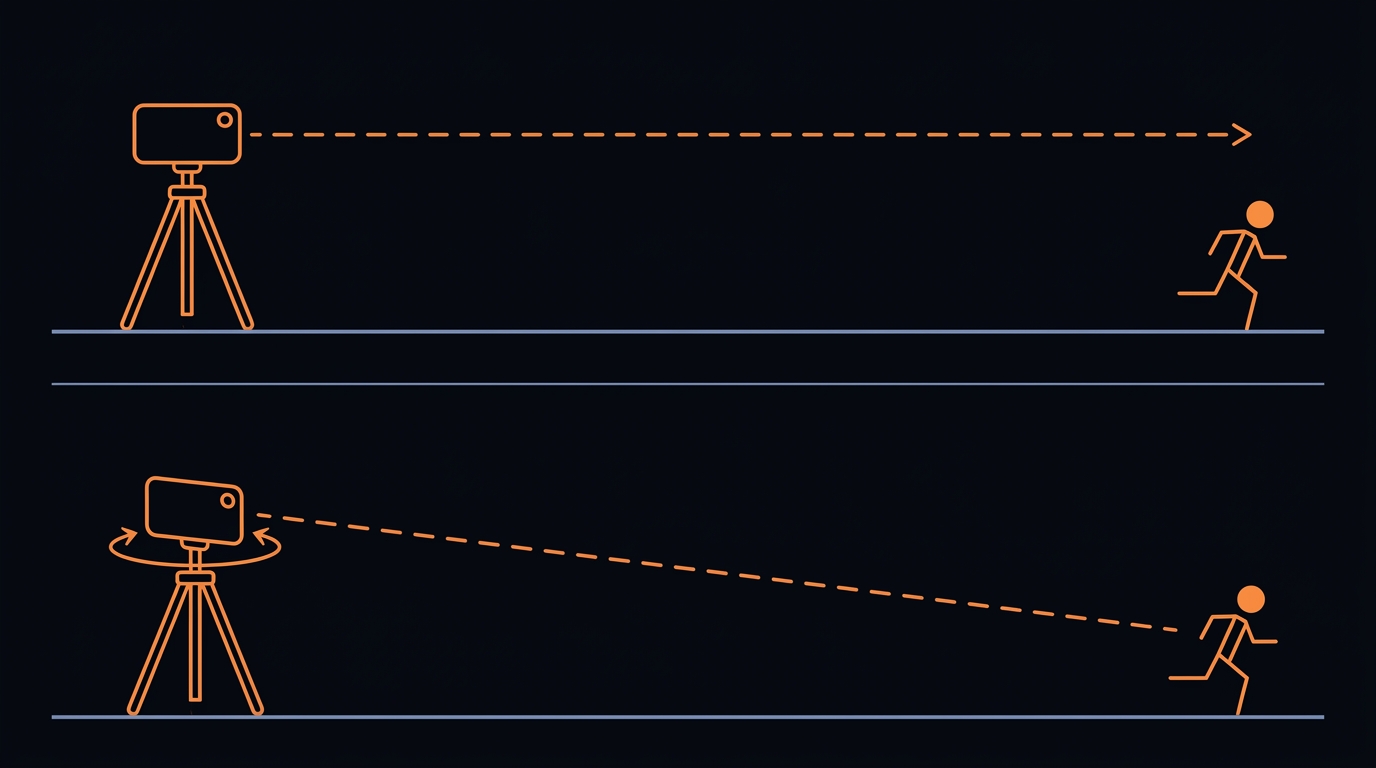 Phone left behind
Panning is not a fix
Phone left behind
Panning is not a fix
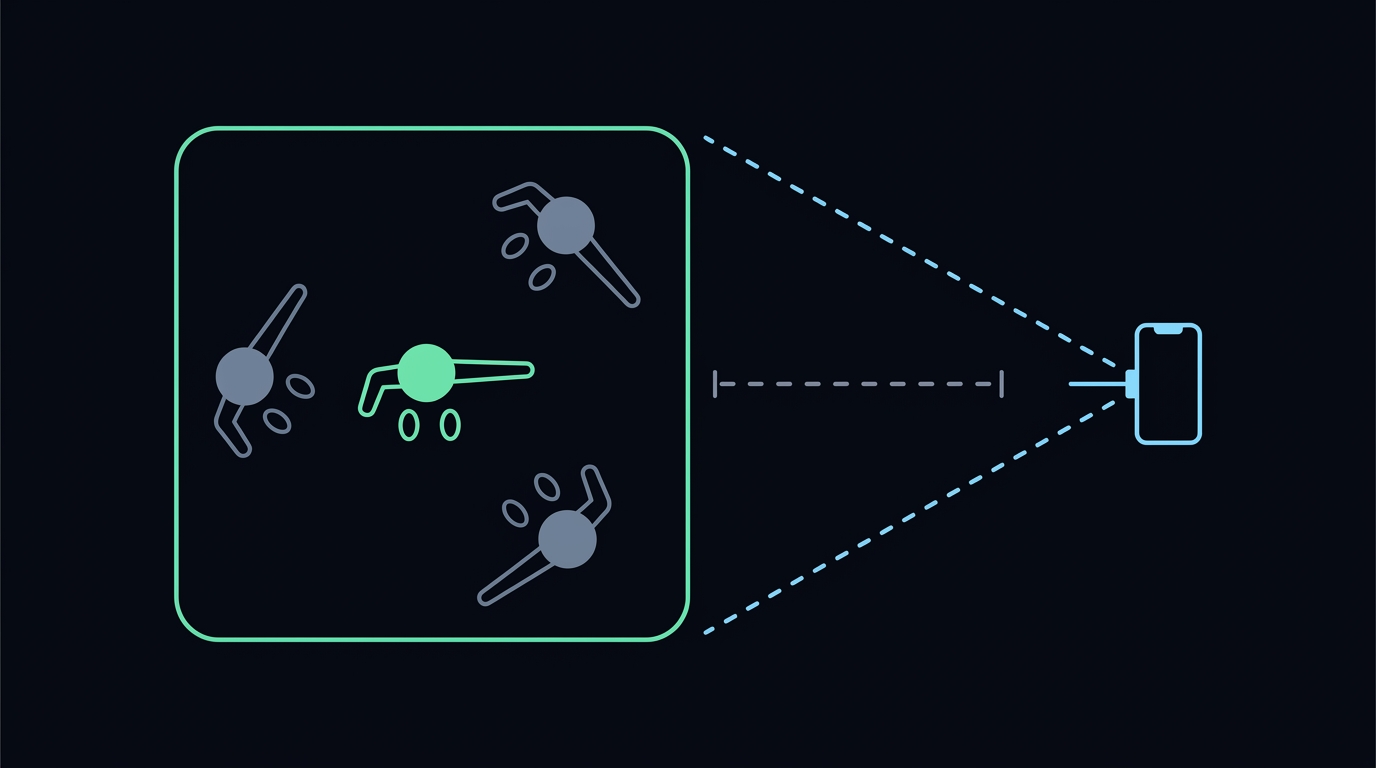 Your working area
This distance never changes
Your working area
This distance never changes
And one that is simply out of scope: this is not for barbell work. No squats, no bench, no presses. It measures the timing and sequencing of fast functional movement — throwing, jumping, running, punching — and a loaded lift asks a different question with a different answer.
Two of our own clips. Same measure, two camera positions.
Both of these tracked cleanly. The skeleton is locked on in both. The only difference is where the phone was standing.
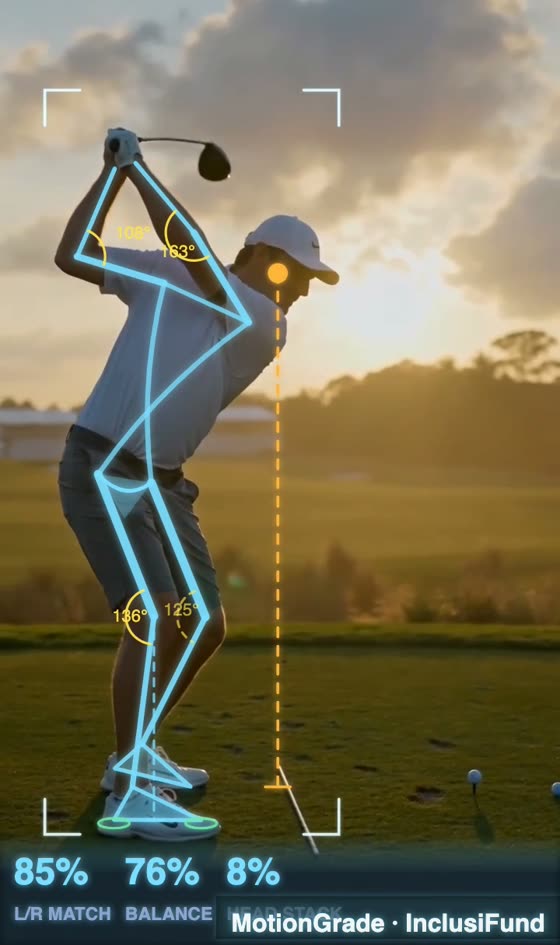
Look at the feet — they sit almost on top of each other. That's a textbook golf camera position and the tracking is fine, but the stance has almost no measurable width left, so the measure built on that width collapses.
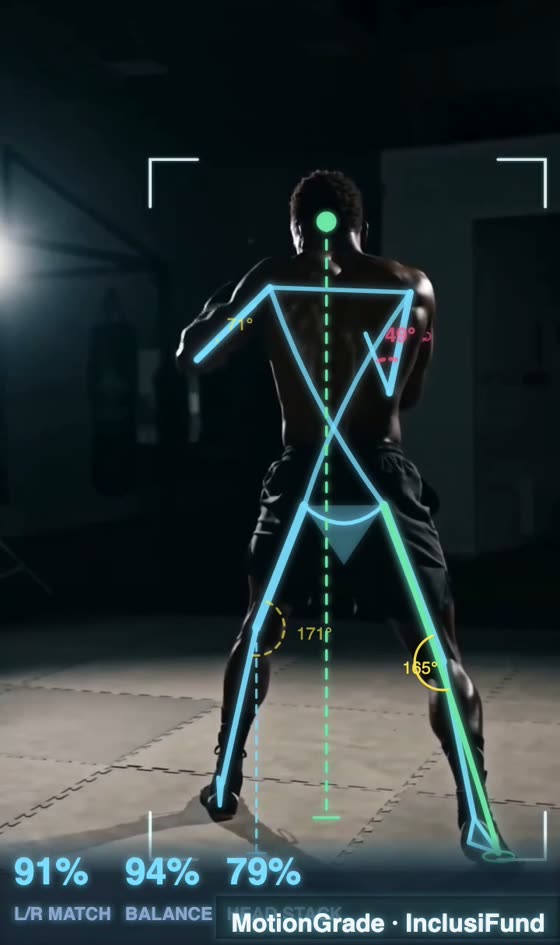
Both feet clearly planted, clearly apart. Same tracking, same overlay, same product — but now there's a base to measure against, and the measure comes back.
We're showing you a bad score on purpose. That 8% is the tool being honest, not the tool being broken — it would have been trivial to return a confident-looking number from that clip, and most things do. A score you can't trust is worse than no score, because you'll coach off it.
Eight things that decide your read.
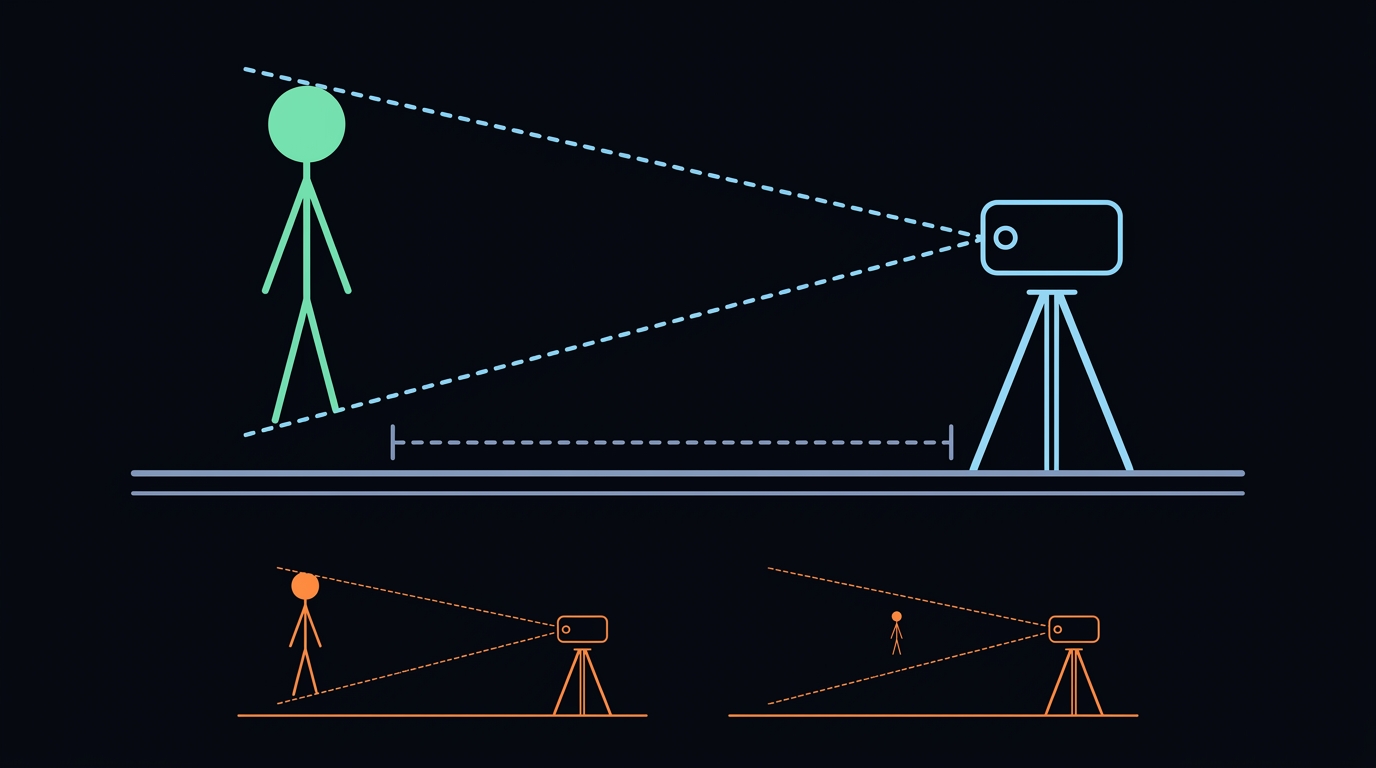 Whole body inside the frame
Phone at hip height
Whole body inside the frame
Phone at hip height
- 01
Whole body in frame, head to feet
Not chest-up, not a crop for drama. If we can't find a full person we can't build a skeleton, and everything downstream is guesswork.
Unlocks: all nine - 02
Keep the feet in shot the whole time
The easiest one to lose — you drift, or the phone tilts up as you follow the movement. Feet leaving the bottom of frame for even part of the rep is enough.
Unlocks: Balance · Support · Head stack Lose it and those three go blank - 03
Turn a quarter-turn off the line of your feet
If the camera sits along the direction your feet point, one foot hides behind the other and there is no measurable base. Step around until you can see daylight between them.
Unlocks: Balance · Head stack · sharper left/right match - 04
One person in shot
A training partner, a spotter, someone walking behind you — with two bodies in frame you'll be asked to tap which one is you, and the rotation read gives up entirely.
Costs: Sequence, plus an extra step before you see anything - 05
Fill about half the frame with the athlete
Pretty wide shots look cinematic and measure badly. Fewer pixels on your body means worse joint detection. Roughly half to two-thirds of frame height is the sweet spot — step the camera in, don't zoom.
Improves: every joint-angle read - 06
One continuous take. No cuts, no edits.
Tracking dies at a cut and does not always announce it — the numbers on screen can keep showing the last good values over footage nothing is reading. Send the raw clip, not the edit.
A single hidden cut can invalidate everything after it - 07
Shoot at 60fps if your phone offers it
The frame rate you filmed at is a hard ceiling on how finely we can read a fast movement. We can slow the footage down to squeeze more samples out of it — quarter speed roughly doubles them — but only up to what the camera actually captured. A 30fps clip saturates and stops improving; a 60fps clip keeps getting sharper. It costs you nothing but a setting.
Sharpens: every angle at speed — the faster the movement, the more it matters - 08
Give us several reps, not one
This is the whole point of MotionGrade. One rep is a snapshot; the grade is about whether your technique held across the set. Three to six reps in one take beats a perfect single.
Unlocks: the session grade itself
Not all nine fail together.
Timing measures are robust. Anything that needs your base is fragile — which is why rule 02 and rule 03 carry so much weight.
- ✓
Survive almost any angle
Tempo · Hand speed · Rhythm · Range. These follow your hands and the shape of the movement over time. Get the body in frame and they read.
- !
Need your feet visible
Support. No feet in frame, no read — there is nothing to stand on in the footage.
- !
Need feet visible and a turned camera
Balance · Head stack · Left/right match. These are measured against the width of your stance. Film along the line of your feet and that width collapses toward zero, which is where the score stops meaning anything.
- ?
Never promised in advance
Sequence. Rotation is only readable from some angles and we won't know until we've looked. If it can't be read honestly, it's left blank rather than guessed.
The app tells you this up front, before it analyses anything — "this angle should give you 6 of 9 measures" — while you can still re-film. If you see a number you don't like there, move the camera and go again. That's cheaper than a bad read.
Film it the way you'd want it watched.
Phone still, on something
Prop it, lean it, tripod it. Handheld drift is the quiet killer of feet-in-frame.
Light on you, not behind you
Shooting into a window or the sun turns you into a silhouette. Silhouettes have no joints.
Side-on, feet apart in view
If a coach standing there couldn't judge your base, neither can we.