Stop pausing the video to draw the lines yourself.
Every coach, PE teacher and athlete analysing movement does the same manual work: scrub frame by frame, draw the angles on the screen, explain it, start again on the next rep.
MotionGrade does it to every rep automatically — joint angles, balance, left/right match — then grades whether the technique held across the whole session, and teaches the biomechanics underneath it.
The work is already being done. By hand.
This isn't a habit anyone needs persuading into. Look at how movement gets analysed today and you're watching people do a job a machine should have taken off them years ago.
Film the movement. Scrub back. Pause on the moment you think matters. Draw a line down the spine with your finger. Screenshot it. Try to explain what you're seeing. Realise the next rep was different. Start again.
Twenty minutes to produce one annotated still — of one rep, chosen by whoever was holding the phone.
Upload the clip. Every frame gets the skeleton, the joint angles, the plumb line and the ground contact. Every rep gets nine measures. The set gets a grade for whether it held together — and a breakdown of the biomechanics at quarter speed.
One upload. Every rep. Nothing drawn by hand.
Same manual job. Four different reasons it hurts.
- ◎
Coaches & trainers
You can see the fault in three seconds. Proving it to the athlete is the twenty-minute job — pausing, drawing, "look, here, see how it opens early?" — and they nod without seeing it. Your eye was never the bottleneck. The evidence was. MotionGrade builds the exhibit for you, on every rep, so the conversation starts where it used to end.
- ✎
PE teachers & biomechanics lecturers
Joint angles and the kinetic chain taught off a textbook diagram of a body that isn't theirs. You hand-annotate video for every session and it's still static and still generic. Point this at a student's own movement and the diagram becomes theirs, with the numbers live on it.
- ▲
Athletes training alone
What you feel and what you do are different things, and nothing in the room tells you which. You film yourself, watch it back, and can't tell — because you don't know what to look at. And nobody ever watches rep eight. This does, and tells you where it went.
- ▶
Creators
Movement content is hard to make teachable. "Here's my swing" isn't a video. "Here's my swing, and here's the read showing it fell apart on rep four" is. The analysis is the post — so using the tool and making the content stop being two jobs.
The read, on real clips.
Joint angles, plumb line, ground contact and the running score — tracked frame by frame, not stamped onto one still you picked by hand.
Where you stand decides what we can read.
Two of our own clips. Both tracked cleanly — the skeleton is locked on in both. The only thing that changed is where the phone was.
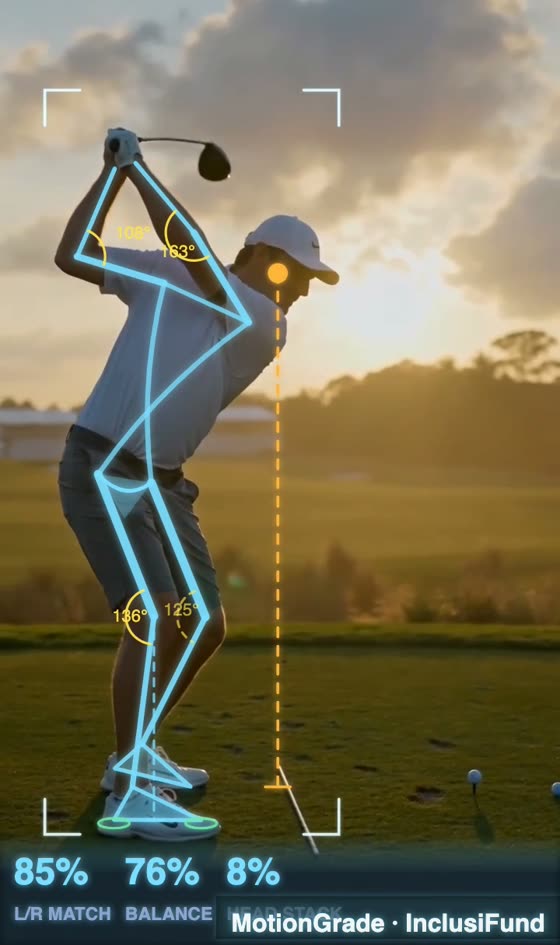
Look at the feet — almost on top of each other. No measurable base, so the measure built on it collapses.
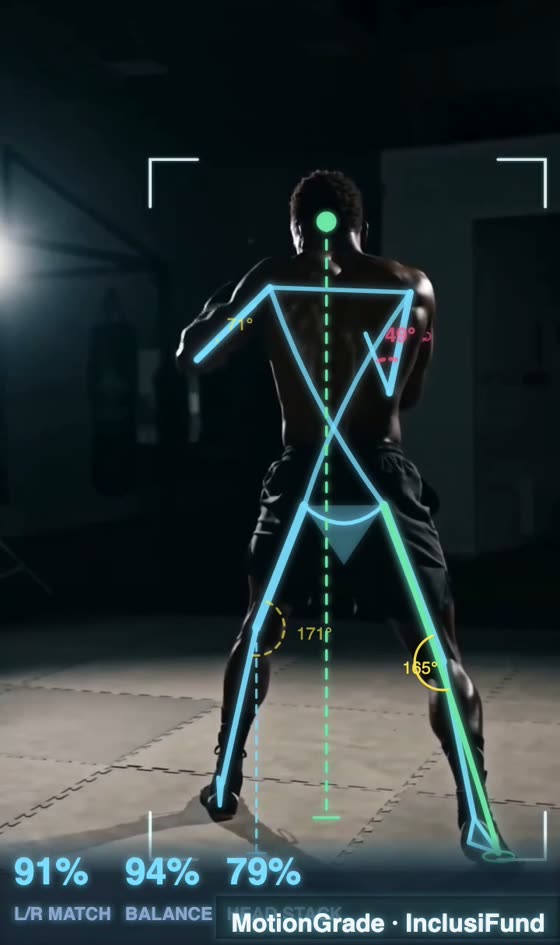
Both feet planted and clearly apart. Same tool, same overlay — now there's a base to measure against.
It's one step sideways.
Not a lens, not a rig, not a second person. Move the phone a quarter-turn around whoever's moving, so it can see the gap between their feet.
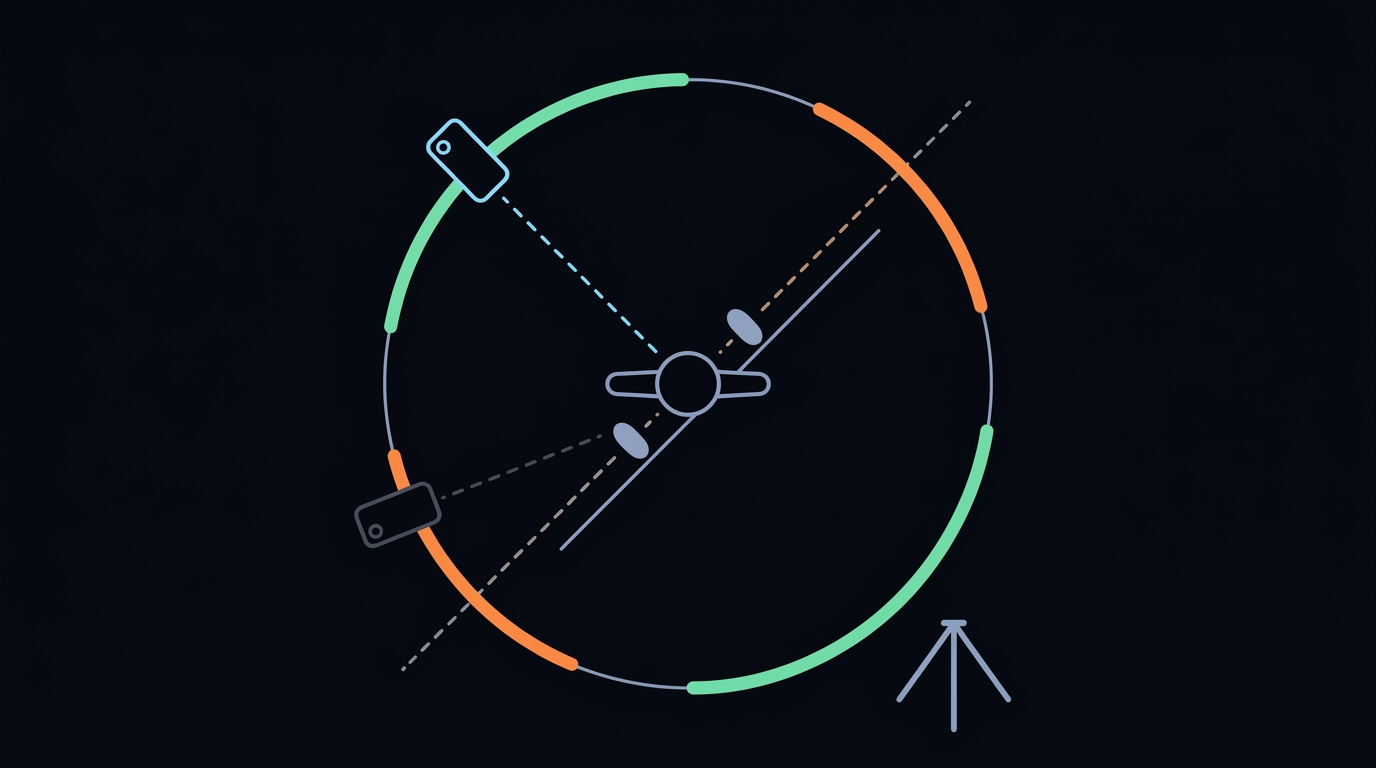 Camera sees both feet
One foot hides the other
Your stance line
Camera sees both feet
One foot hides the other
Your stance line
Seven more like this, and what each one buys you: the filming guide →
Film it. Grade it. Understand it.
Film your movement
A run, a lift, a swing, a flow — one clip on your phone, several reps in one take. No sensors, no markers, no lab.
Get the grade
Nine measures on every rep, scored against each other — so you see whether the technique held across the set, not just whether one rep looked good.
Learn the why
A coach breakdown plus the physics and biomechanics of the movement at 0.25× — so you build a real relationship with what the body is doing.
Step 01 is the one people skip. The angle you film from decides how much can be read at all — so we wrote it down: how to film for a full read →
Three differences that actually matter.
The whole session, not one rep
Drawing on a still can only ever describe the moment you chose. Consistency across a set is the thing that separates trained movement from lucky movement — and it's invisible unless something reads every rep.
It explains, it doesn't just measure
A number tells you that something is off. The biomechanics breakdown tells you why it happens and what changes it. Coaches don't need a scoreboard; they need the argument.
It tells you what it can't read
Film from a bad angle and most tools hand back a confident number anyway. This one says so up front — "this angle gives you 6 of 9" — while you can still re-film. You can't coach off a score you don't trust.
Founding cohort
Free access before launch. You get graded and coached; your best clips may feature when we go live.
Get coached, not just scored
Coach breakdowns, 3–5 drills built for your exact movement, and the biomechanics behind them.
Join the athlete cohort →The analysis is the content
Turn the movement you already film into breakdowns your audience stays for — ahead of launch.
Join the creator cohort →Already in the cohort? Open MotionGrade → (you'll need the access code from your welcome email)